Monday, June 29, 2015

What I Did This Year

My master’s thesis, which I spent most of this year working on with my supervisor, Chris Yau, contains 83 pages, 82 equations, and 13,000 lines of code, but because you are brilliant I am going to explain it here in 800 words (plus one 300-word note on what I learned from the project) and you are going to understand all of it.


The thesis develops better ways of performing two important statistical tasks on a widely used type of biological data. First I’ll explain the data, then I’ll explain the tasks, then I’ll explain what we did.


The data is called single-cell gene expression data. In a previous post I explained why we like gene expression data: it tells us how much RNA cells produce from their genes, which tells us which genes are important to the cell’s functions.


Before, we could only measure gene expression data by combining hundreds of cells: otherwise there wasn’t enough RNA to measure. But single-cell gene expression data lets us measure RNA levels within single cells. This is exciting because rather than pretending that all the cells in a tissue, or a tumor, are identical, we can look for groups of cells which are different in important ways. It’s like the difference between asking “What are Americans like on average?” and interviewing individual Americans. (We’re not all bad!)


These differences between cells matter because they have implications for how we treat disease. For example, single-cell analysis reveals that brain tumors which are classified as a single type in fact contain mixtures of multiple types of cells. And this diversity makes the tumors harder to treat: the more diverse the tumor is, the worse the patient’s prognosis, possibly because treatments that work on one group of cells don’t work well on the rest of the cells.


So people are writing papers saying single-cell data will “revolutionize” science. (I would write papers saying things like that, but no one pays attention to me.) Unfortunately, single-cell data is also hard for standard statistical models to deal with, because it has a lot of “zeros”: cells where we cannot detect any RNA produced from a gene. If you plot how much RNA is measured from a gene, it looks like this:
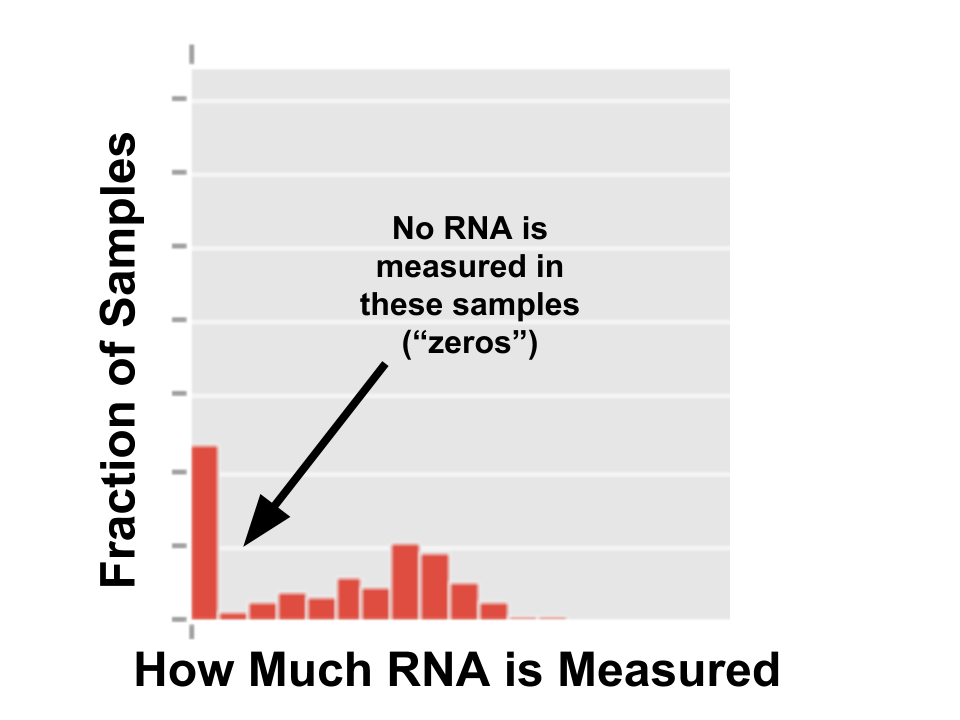
The spike at zero is bad because many statistical models assume data is Gaussian -- that is, it makes a nice blob, pictured below.
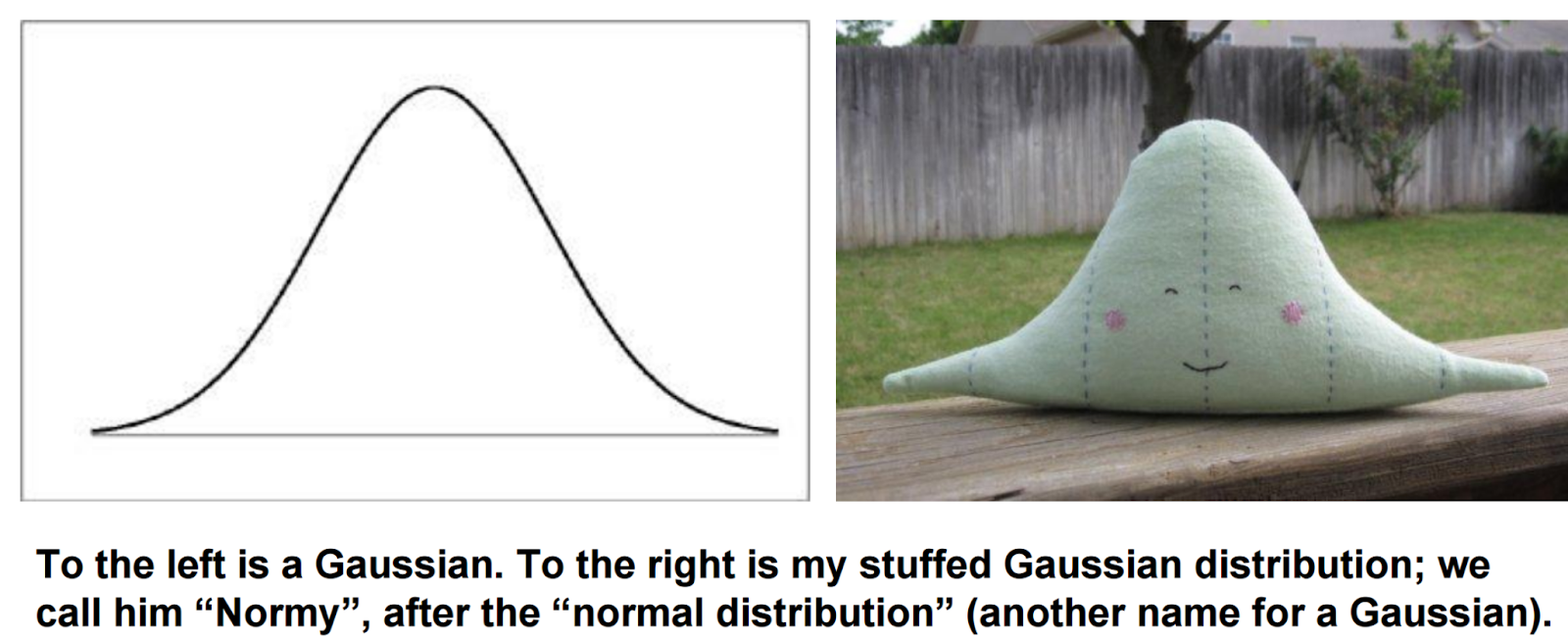

Obviously, the spike at zero in single-cell data makes the data very not Gaussian, and this makes it harder to perform many statistical tasks. Specifically, there are two things we often want to do with data -- cluster it, where we divide cells into groups so that similar cells are put into the same group, and reduce its dimension, where we plot cells in two (or more) dimensions such that similar cells appear close together [1]. Standard methods for performing these tasks assume the data is Gaussian.


In my thesis, we first develop a model for the patterns of zeros in single-cell data, and, based on this model, show that zeros really do hurt the performance of standard methods. We show, in several different datasets, that genes that are expressed at a higher level are less likely to be zero, and develop a model that describes this relationship. (I describe the mathematical details here [2].) Based on our model, we generate simulated data and show that the performance of standard statistical methods gets worse as we add zeros. Here’s a demo: move the slider to add zeros, and watch how the clusters (which are supposed to be separate) get mushed together. This is bad. We have an important new type of data; we have important statistical tasks that we often want to perform; standard methods for performing the tasks do not work well on the new data.


Diagnosing the problem is easy; how do we fix it? We develop two new models: a clustering model (ZIMM, for zero-inflated mixture model) and a dimensionality-reduction model (ZIFA, for zero-inflated factor analysis -- new statistical models are required to have a cool acronym). I give more details on how we developed the models in this footnote [3]. We show that our models do a better job than standard models on both simulated data and real biological data and put the code online so other people can use them. We are giving talks on the work at various venues, and a paper is under review. If you’re interested in using or extending these models, feel free to send me or Chris an email.


While we developed these models for single-cell data, they are potentially useful for lots of other datasets which have many zeros or missing datapoints. In the thesis we discuss several examples: recommendation datasets (how much will a person will like a product? -- see, for example, Netflix’s million dollar competition to predict movie ratings), usage datasets (how often a person will use a product?) and network datasets (how strongly are two nodes, eg airports, connected in a network?) Feel free to read the last chapter of the thesis and let me know if you have ideas for further applications (translation: do my homework for me).


Working on this project taught me about the role of luck in research. I often feel there’s a great deal of luck when you investigate some cool statistical hypothesis (“older women with cats are more likely to be single”). The hypothesis may or may not turn out to be true, but its truth doesn’t depend on how good a scientist you are. This luck evens out, though, because better scientists a) look at more things b) look at more interesting things c) look at them more rigorously.


You might think, though, that when you’re just doing math rather than observing the world, there’s no luck involved, only skill; equations are within your control. Still, my experience this year makes me feel there’s still luck involved, and I’ll draw an analogy to chess. Chess, in theory, is a game with no luck; there’s no dice, no drawn cards. But you will still hear chess players say “I got lucky” (or, more often, “I got unlucky”) because they calculated ten moves ahead, and on the eleventh move, their queen happened to be in the right place, and so they won, but they didn’t foresee it.


Similarly, my thesis involves about ten pages of algebra, at the end of which the math works out nicely. But I didn’t know this would happen when I began; this is what I mean by getting lucky.


Again, though, I feel the luck evens out here. I may occasionally beat a chessplayer who sees farther ahead than me because my pieces end up in the right place, but most of the time I’m going to lose. Similarly, I have met mathematicians who can see further down a proof tree than I can (and also have an eerie instinct for which branches will yield fruit) and they can prove trickier things than I can. In the case of my thesis, while we got “lucky” in the end, we also had to fix my screwups revise our approach several times; the final product feels like the result of a lot of blood, sweat, and tea [4]. Or maybe I’m just saying that so Oxford will let me graduate.


Notes:
[1] For each cell, we have data for tens of thousands of genes. It’s very hard to visualize or analyze data with ten thousand dimensions. So we want to reduce ten thousand to something more manageable, like two, in a way that preserves basic patterns in the data.
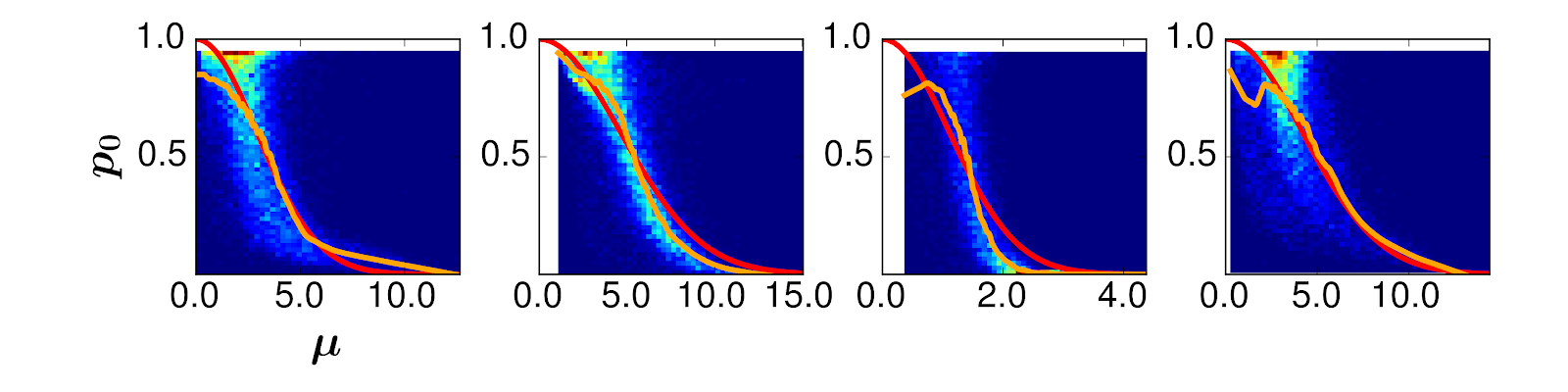
[2] Call the probability that a gene is zero p0, and the average expression of a gene when it’s not zero μ. Then, p0  = exp(-lambda*μ2), where exp is the exponential function and lambda is a parameter we fit to the data. Here are four different real biological datasets: the orange line is the actual data, and the red is our fitted model. You can see the orange line fits the red line pretty closely.

[3] Here’s a two-step procedure for developing statistical models:


  1. Write down (using math) the process you think generates the data. This is usually the straightforward part. In the case of ZIFA and ZIMM, our process is “generate data using a standard statistical model. Then, add zeros to that data”.
  2. Your model will have “parameters” -- numbers that affect the predictions it makes. For example, if your model is
    number_of_colleges_you_get_into = A*your_SAT_score + B*your_parents’_income
    then A and B are parameters of the model. Obviously, in order to calculate useful things with a model (in this case, how many colleges you are expected to get into) you need a way of figuring out the values of the parameters (for example, A = .01, B = .001). This is the hard part; it took me most of the winter.
[4] The British do not cry, or if they do, they cry Earl Grey.



Tuesday, June 9, 2015

So Maybe I Am (Partly) An Affirmative Action Admit


The day I got into MIT, I listened to the boys in my high school physics class whisper that girls had gotten in just because they were girls. Half the female undergrads at MIT have heard such comments, in part because female applicants to MIT are accepted at a much higher rate than male applicants. The explanation given by the MIT admissions office is that girls don’t apply unless they’re especially well-qualified, because MIT is a school that excels in stereotypically male areas.

Though I ended up turning down MIT for Stanford, still I wondered if my gender had helped me get in. My high school class elected me “nerdiest girl”; my application highlighted my interests in male-dominated areas like math, physics, and artificial intelligence. As a nerdy girl, I was an outlier; as a nerdy boy, I would’ve been a stereotype. Two of my acceptance letters commented on the fact that I played chess, a male-dominated game.

So I was excited when I learned that Stanford was required to provide the comments admissions officers had made on applications. When I tried to obtain these comments, I discovered that Stanford does pretty much everything it can to prevent you from getting them [1]. You get an email asking you to “consider the administrative and logistical burden” and whether your life will “be better for having reviewed them”. They will not send you the records via email; when I showed up in person, an employee told me I would not be allowed to use a phone or computer to take notes.

“Can I just have a copy to take home?” I asked.

“No,” he said. “You have twenty minutes.” He started a timer, and I began copying out the comments word for word.

My application was reviewed by two people. It is clear my gender mattered to the first reviewer, who referred to me using terms that emphasized that I was female and discussed my essay about playing chess on Chicago’s South Side with a bunch of older black men. “I can just visualize this young white woman talkin’ trash and kickin’ butt in the South Side chess joint,” the reviewer wrote. Would the image have been as charming had I been male?

Then I emailed every other college I applied to to request my admissions records, because that is a totally normal thing to do. They all told me, politely, to go away; probably the “Stanford” in my email address didn’t help.

Based on the comments on my admissions letters and my application, I conclude that my gender may have helped me get in. A non-rigorous survey of my Facebook friends revealed that I am not the only female scientist who wonders about this. About half of the female scientists who answered said they thought it was possible they had earned an opportunity in part because of their gender. (Some fiercely rejected the idea -- “I topped my university because I am smart and worked hard and not because I am a girl!” -- while some took a more moderate position -- “I think it doesn't hurt to be female when applying to places... In general, I try to work hard enough so that my ability/merit is at the level where it's so clear they should accept/hire me that gender isn't even a question.”)

How much does the possibility that my gender helped bother me? Not much, for three reasons.

  1. Most of me believes that I would’ve gotten in had I been male, that I am not just good at math “for a girl”. I did better on most college math tests than most of the the guys in the class. I also took one math class under the psuedonym “Andrew Chang” and the gender switch didn’t make much difference. (If anything, incidentally, graders in math classes are biased against girls).
  2. Even if I wouldn’t have gotten into the same schools, I’m okay with schools giving preference to girls in male-dominated fields. Colleges should admit people based on their potential, not just their current position. And a high school girl in the male-dominated fields faces so many handicaps a boy does not -- social pressure to leave, stereotype threat, bias -- that if she nonetheless achieves the same score on a math test, that seems like evidence that she has more potential. (Similarly, we’re more impressed by the kid who manages to teach himself integrals out of a textbook than the kid who goes to a school where everyone takes BC Calculus.) I also believe that a gender-balanced college environment is a better one, both because of the sexism which can flourish in male-dominated environments and because men and women have reliably different views on certain issues, making gender balance in academic discussions important. (More on this here [2].)
  3. But let’s say you don’t buy any of this and think I was unfairly admitted to college. Honestly, I still don’t really care because in terms of things I’ve been unfairly given, I’ve got way bigger problems. My graduate education is funded by a) a guy who’s literally getting feces thrown on his effigy b) the US military and c) an organization with a strong history of supporting the nuclear arms race. I am constantly forgetting my keys and being let into buildings anyway because I am white and am carrying a nice laptop, and let’s not even talk about where the laptop came from. In contrast, the people harmed by an affirmative action preference towards me are men who are better than I am at computer science. I’ve met a few of those guys. They’re doing okay.

You might say this is a non sequitur because the presence of a larger injustice does not mean we should ignore a smaller one. I agree that it is important to consider how much affirmative action we really want, and to study, for example, whether or not female scientists have an advantage in applying for jobs. But in terms of injustices that I personally contribute to, I have bigger things to worry about. And if you are one of the dozens of guys from my high school who is annually rejected from MIT: before making nasty comments about how unjust the system is, you might consider how many injustices have already gone your way. 

Notes:
[1] This is not the first time I have found college officials reluctant to provide information on admissions processes. While touring computer science graduate programs, I spoke with one dean who told me his department had changed their admissions criteria to increase the fraction of women admitted to the program. Without thinking, I asked, “So am I statistically dumber than my male peers?” I have no idea why I said that, but he hastily backtracked and said, no, it wasn’t me he was talking about, it was the undergraduates. (In any case, “dumber” was an inflammatory and incorrect word to use; he had been talking about correcting for women’s lack of experience coding.)

[2] I am troubled by the sexism that often seems to take root in male-dominated environments like fraternities, tech companies, venture capital firms, and gaming communities; women who work in male-dominated environments also often report feeling isolated, which makes them more likely to leave. Gender balance in academic discussions is also important because, while gender gaps for most traits are small, men and women have reliably different views in some areas -- political orientation, sex discrimination, sexual assault. Even within the supposedly objective academic research world, it is clear that a researcher’s gender influences what they choose to focus on. It is no coincidence that many of the high-impact papers studying gender -- on bias in orchestral auditions, gender gaps in desire to compete, and gender inequality in deliberative participation -- have female authors, or that gender studies departments tend to be mostly female. Would medical experiments have been performed only on male lab animals (controlling for the menstrual cycle is a pain) had more of the experimenters been female?

pearson pearson pearson

Wednesday, May 27, 2015

Things I've Learned About Academic Work From Playing Age of Empires

We all have guilty pleasures. Mine is playing Age of Empires, a strategy game in which you build a military and try to take over the world. I play under the handle “StatisticianOfDeath”, and while I am (by online standards) pretty mediocre, I can probably beat you. (The online players who are better than me include, I suspect, people who pee into bottles so they don’t have to take a break, so I’m content to be average.)

Anyway, in an attempt to rationalize the hours I’ve spent slaughtering little imaginary men, here are four lessons I’ve learned about academic work from playing Age of Empires.

  1. Feeling like an outsider sucks, and worsens your performance. I rarely feel like an outsider in male-dominated settings -- computer science classes, chess tournaments -- in part, I think, because I’ve been doing these things since I was quite young. But I definitely felt like I would never be a true Age of Empires player, that there was some secret ability to sack and pillage that I was fundamentally lacking. Part of this was probably due to conversations like this one:

[Waiting to start a game, I notice one of the other players is named “Rapist”]
Me: Uh, Rapist.
Rapist: What’s up?
Me: Uh, you kind of have a terrible name. Maybe you should change your name? A lot of girls get raped. Guys too.
Rapist: Moral f**.
Me: No, just a statistician.
Rapist: I like my name.
Me: Haha, I can see that. Well, you do you.

So I didn’t feel like I fit in, and since I hadn’t been playing since I was 12, I didn’t feel like a true gamer. Consequently, I played too defensively: attacking before your opponent is ready (even if you don’t have much of an army) gives you an advantage. This was especially bad because I played as the Goth civilization, and since they can’t build walls, they have to attack or they lose.

Here is the part Sheryl Sandberg would approve of: with the help of my boyfriend (whose handle is “LIGAMENT_ANNIHILATOR”: I think this is better than “Rapist” because very few people get their ligaments annihilated) I gradually learned to “lean in”, by which I mean “send long swordsmen into the enemy’s base when I wasn’t feeling quite ready”. The analogue in research: if you tend to be underconfident, go for it even if you aren’t feeling 100% prepared, because odds are your rivals aren’t either and you will slaughter their villagers do a good job.
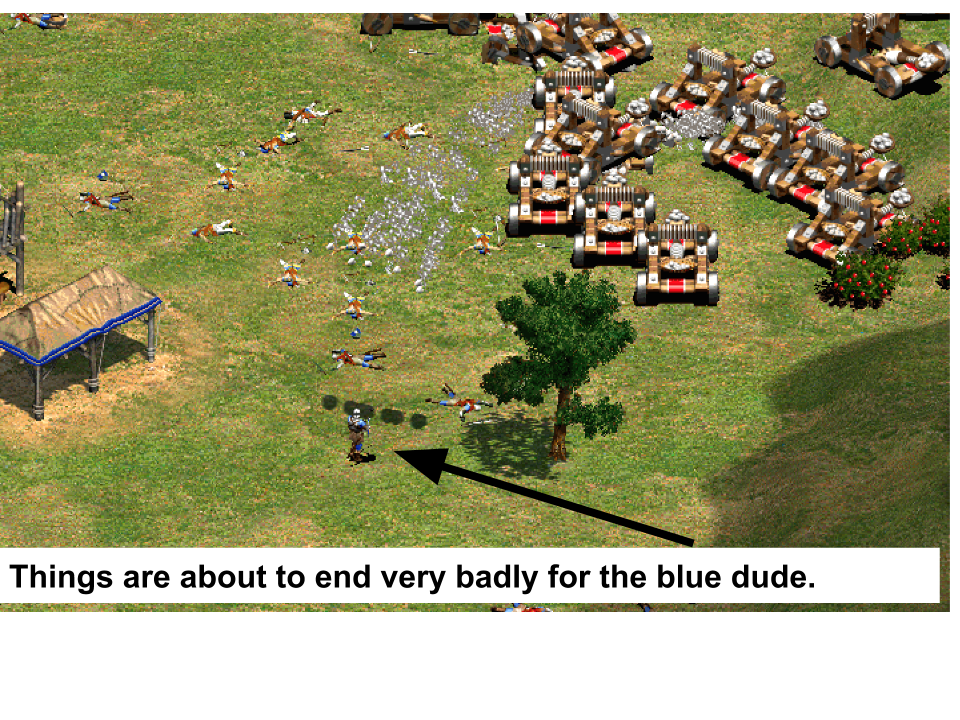
  1. There are huge gaps between people who are good and people who are mediocre. I am rated about 1600 in Age of Empires. A player who is rated 1700 will consistently beat me, and it won’t be pretty; I will have an army of like 8 dudes, and they’ll show up in my base with like 80 fire catapults.

When you lose in Age of Empires, you lose emphatically. The 1700 will be consistently beaten by an 1800, and I’ve seen 2200s on the site. The ladder of skill, in other words, ascends a long way.
This is also true in coding: it’s often said that great programmers are 10 times as productive as mediocre programmers. Certainly I know mathematicians and computer scientists whose brains just work on a different level than mine does. Whether you’re trying to finish some code or build an army of knights, if you’re wondering whether there’s someone who can do it way faster than you, the answer is probably yes.

  1. The difference between success and failure can be the amount of resources you throw at a problem. Age of Empires does not reward subtlety. You don’t win a game by creating a single Barracks and sending in Seal Team 6 (or its medieval equivalent); you build 9 BARRACKS AND THEN YOU RESEARCH CONSCRIPTION AND PERFUSION AND CHURN OUT 5 HUSKARLS A SECOND AND BLOOD MAKES THE GRASS GROW! KILL! KILL!
Sorry. Similarly, in statistics, I often find that I have to look at a dataset 14 different ways to find the one that’s worth writing about. People come to me complaining about a dataset because they tried one thing and it didn’t work. The first thing I try hardly ever works. It is a question of a) getting fast enough that you can try a lot of stuff quickly and b) trying a lot of stuff. (Caveat 1: I am not saying that you should examine 14 different hypotheses and report the one which is significant with p = .048. Caveat 2: obviously, some instinct for the problems worth examining is helpful. But my accuracy is far below 100%.)

  1. Sometimes you just have to batter a problem into submission. When a player is on the defensive, they sometimes just build four layers of walls. This is an obnoxious strategy, and really the only way to deal with it is to bring in siege weapons -- trebuchets, catapults, rams -- and batter down the walls. A lot of academic work, I think, is like this -- you know what needs to be done, but it’s not that intellectually engaging, and you just have to batter the walls down. Philip Guo, who completed his PhD in computer science, refers to the process as the “PhD grind”. But I prefer to think of it like this:


In case you’re wondering, yes, I did actually play Age of Empires so I could make all those diagrams myself.

Saturday, May 23, 2015

Three Hundred Thousand Stories

Content warning: sexual assault, mass shooting, profanity.


One year ago today, a 22-year-old named Elliot Rodger killed six people in an effort to “destroy all women because I can never have them. I will make them suffer for rejecting me. I will arm myself with deadly weapons and wage a war against all women and the men they are attracted to. And I will slaughter them like the animals they are”.


I do not want to write about Rodger. He deserves to be forgotten. I want to write about what happened afterwards, which is that Twitter exploded with the hashtag #YesAllWomen: thousands of people protesting sexual violence and sexism more broadly. Over the next month, I collected more than 1.13 million posts, more than 300,000 of them unique. I have studied many Twitter discussions, but I think this was the most extraordinary, an event unprecedented in history. Rape so often ends in silence: from Alaska to South Africa, college campuses to military barracks, the majority of sexual assaults go unreported, and the vast majority of assaulters walk free.


407 people told stories of being raped in my dataset. As I counted their stories and marveled at their courage I found myself wanting to reach out, like Darth Vader, and choke the life out of those who had hurt them. They were painting a picture that transcended any single tweet: who cared enough about sexual violence to speak up about it, how men and women had spoken differently, how the movement had evolved, who had tried to attack it. Because statistics can never replace individual stories, I also spoke to the most prolific tweeters, who ranged from scientists to sexual assault survivors, dominatrices to grandmothers. This is what they told me.


*


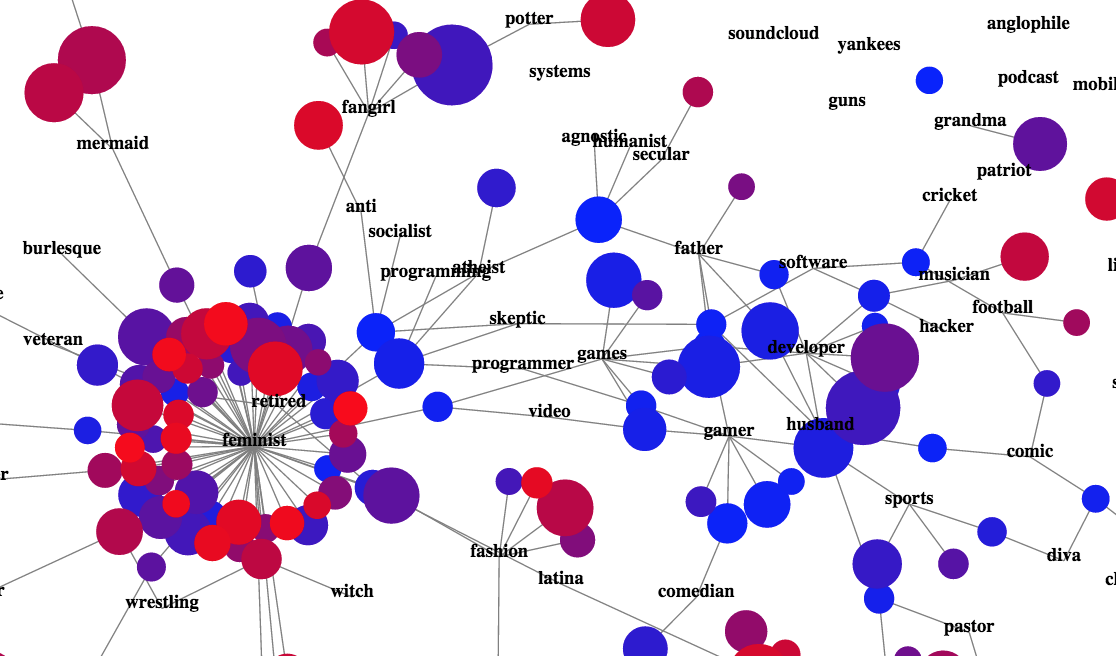
Three quarters of the tweeters whose gender I could identify from first name were women [1]; they were 10 times as likely as the average tweeter to describe themselves as feminists, and also more likely to describe themselves using words like “gender”, “equality”, “atheist”, “literature”, “violence”, “queer”, and “vegetarian”. To understand how their backgrounds influenced what they cared about, I made a visualization connecting tweets to the words tweeters tended to use to describe themselves. Here’s a screenshot; tweets are circles:
Screen Shot 2015-05-23 at 1.53.01 PM.png
You can see the interactive version and read the tweets here. It shows atheists retweeting "#YesAllWomen are treated like property in the Bible... but extremely valuable property! Like, worth as much as dozens of cows!" It shows men saying that they can do better. It shows gamers and video fans discussing gender inequality in online videos: "When a woman makes a video, most comments are about tearing apart her looks ... with a man, almost none."


But to me the most moving thing about this picture is its lack of pattern. Maybe you can see systematic differences in what yogis and daughters and actresses tweet, but as a statistician trained to find differences in data, I see instead a universal rage: all women face violence and misogyny. Perhaps their only common element is their courage: as their Twitter profiles attest, they are female, fabulous, and fierce.


Of course, there’s a lot more to someone than their Twitter profile reveals. So I wrote to the most prolific tweeters to learn more. Some of them had tweeted thousands of times, and had faced so much harassment for doing so that they were reluctant to talk to me. One, a former dominatrix, told me that need for money had driven her down dangerous paths, teaching her that “a group of men in the world and even some women expect there to be an underclass of people whose lives and bodily integrity just matter less than people's desire for entertainment.”


A second tweeter was a grandmother (never let it be said that they don’t use Twitter), who told me she got “granny-angry”. A survivor of sexual assault and domestic abuse who worked for two decades as a victims’ advocate, she spent a summer posting obsessively -- “I was determined the damned misogynists weren't going to hijack the tag” -- building support with the other frequent tweeters even as they were threatened and, occasionally, publicly identified online.


A third woman, a scientist, got angry at the “flood of trolls” saying “Rape claims are inflated” or “Be grateful you don’t have REAL problems.”


“I was so sick of seeing ‘cite your sources’ from men insulting women who had been raped...that I decided I’d cite ALL the sources,” she said. So she began tweeting out the conclusions of dozens of academic papers on assault.


“A man told me ‘shut up, no one cares,’ ” she said.  “I said ‘Obviously you do, or you wouldn’t be trolling this tag.’ In response, someone else told me to die and threatened to rape me. I reported it as a violent threat, only to have Twitter respond—two days later—that it wasn’t violating their terms of service.”


Interestingly, in spite of these attacks, the vast majority of tweets containing #YesAllWomen supported the hashtag, and most posters saw their number of Twitter followers increase. Still, I wanted to understand who, exactly, attacks a woman discussing her own rape, so I identified widely shared anti-#YesAllWomen tweets and studied the people who shared them. Like the pro-#YesAllWomen tweeters, most of these anti-#YesAllWomen tweeters had more followers a month later, probably indicating their different social circles. I contacted several of the attackers to determine their motivation, but they were not terribly interested in having a serious conversation with a woman studying a feminist tweet, and several preferred to harass me instead. So I resorted instead to my other strategy for getting to know people: I downloaded 1.5 million of their tweets. While I was tempted to homogenize the attackers, I found diverse clusters. Some were high profile, including a mixed-martial arts champion, a conservative commentator and comedian, and a Peabody Award-winning actor; the less high-profile tweeters included political conservatives and wrestling fans. One of the most prolific, who tweeted more than 1,700 times(!) in my data, highlights their diversity: she is, to quote her Twitter profile, “into Wrestling, Catfighting And Sexfighting”, “A Domme Who Conquors Her Slaves” and “Gay But...Do Not Hate Men!”. Ironically, she was upset about the same thing many pro-#YesAllWomen tweeters were: what she saw as double standards. For example, an attractive criminal, like Jeremy Meeks, got women asking to be raped, while a less attractive criminal would not; women who beat up men were powerful, but men who beat up women were abusers.


Because men and women often have different perspectives on sexual assault, I also spoke to men who tweeted prolifically. Two said they were motivated in part by the experiences of women they cared about.


“I've had close friends come home crying from frat parties after a ‘rodeo’ gang rape,” one said. “I've worked jobs where I've seen women slapped on the ass, pinched, whistled at, preyed upon and cowed by management.  I have experienced fear reactions and trust barriers from women...once we're better friends they tell me about the times that they've been attacked.” A second male tweeter said he had been influenced growing up by his mother’s stories of being sexually abused. Both said that other men had questioned their masculinity for defending #YesAllWomen -- “calling me a ‘pussy’, asking me if I ‘had a vagina’ ” -- though one noted he got nowhere near as much abuse as the women.


Then I looked for broader gender differences. Looking at things retweeted mostly by men or women doesn’t reflect too well on the men. The most male-dominated tweets include charming observations like “#YesAllWomen should hit the weight room so they can avoid getting raped wit they weak asses” or “How many Women does it take to change a light bulb? 11, 10 to form a support group, and one to get her boyfriend to do it” [2]. But these tweets aren’t a fair summary of what most men think; rather, they reveal the things that women don’t think. In fact, four of the five most common tweets were the same for men and women.


It’s fairer to compare all tweets from men and women. For example, women use more words expressing fear and use more first-person language. Men use more profanity, and they also use it differently. When men say “dick”, it’s most frequently to retweet, “#YesAllWomen should suck dick on the first date”; for women, it’s “I'm not a tease for letting you buy me a drink and not going home with you. You offered me a drink, not your dick on a plate”. We can also find differences in how people treated those of the same versus the opposite gender. Men used more words expressing emotion, especially negative emotion, when talking to women. Women fired back: more than two thirds of tweets from women containing “part of the problem” were at men.


As I worked on this analysis, the laptop on which I stored the data became a grim weight; walking back to my room late each night, I shied away from the men I passed. But the weight also reminded me I did not walk alone: #YesAllWomen had revealed a vast network of people who shared common fears [3].


One of the tweeters said it best. A survivor of sexual assault who suffers from a severe anxiety disorder, she said she considered not speaking up because of backlash. I asked her why she did anyway.


“Things like this help remind everyone who's had to face these types of oppression... that they are not alone,” she told me. “If my putting my neck on the line means that even one other person who's gone through these things feel just a little more supported, a little more safe, a little more like they can get up in the morning and feel okay with existing and that their life might just work out -- so be it.”


Thanks to the members of the #YesAllWomen movement for trusting me with their experiences, and to everyone who speaks out about sexism and sexual violence.


Notes:


[1] Throughout, when analyzing gender differences, I use tweeter first name to identify gender, a method that works about half the time. It is important to remember that the other half may exhibit different statistical properties. Shoot me an email if you have thoughts on this.
[2] And oh, the many #YesAllWomen lightbulb jokes. A sampling:
“How does a feminist change a lightbulb? She just holds on and the world revolves around her.”
“How many feminists does it take to change a light bulb? None, they can't change anything.”
“How many feminists does it take to screw in a light bulb? Nevermind that, the word screw promotes rape culture.”
The feminists countered with some of their own:
“How many men does it take to change a lightbulb? None because they get mad after it won't screw”
“How many ‘nice guys’ does it take to change a light bulb? No one knows, they keep blaming it for not getting turned on.”
“How many men's rights activists does it take to change a lightbulb? Well, not all of them." #NotAllMen #Butprobablyalotofthem”
[3] Indeed, I found some evidence that the movement gained strength as tweeters combined multiple ideas to make more powerful tweets. In several cases, there was an early tweet about how women had to behave and then a later, more widely shared tweet contrasting women’s experience with men’s.
Early Tweet
Later Tweet
Because you get a "rape whistle" when you start college #YesAllWomen
Because when girls go to college they're buying pepper spray and rape whistles while guys are buying condoms #YesAllWomen
The constant worry your skirt or dress is too short or maybe your bra strap is showing and you'll attract the "wrong attention" #YesAllWomen
a ‘cool story babe, now make me a sandwich’ shirt doesn't break the school dress code. a girl's bra strap does #YesAllWomen


The marketplace of ideas has become, perhaps, the fusion reactor of ideas, where memes combine with explosive power and supporters of a social movement draw strength from each other through digital synapses. But it is important to note that establishing causality is difficult -- how do we know if the second tweeter saw the first tweet? Still, the pattern is repeated and the explanation is plausible.